


While imports and sales of new electric vehicles in 2025 resembled an explosion, the domestic market demonstrated stable evolution. In total, Ukrainians concluded 35,831 electric car purchase and sale agreements during the year, which is 38% more than in 2024.
- Check the history of a car by VIN code before buying with CEBIA!
December stood out in particular: 4,281 transactions, which means an increase of 54.0% compared to November and a significant + 313.2% compared to December last year. This surge in activity indicates that “electric cars” have finally ceased to be exotic and have become a full-fledged part of the secondary market, where the buyer is no longer afraid to buy a used car “on batteries”.
Brands. What is chosen more often?
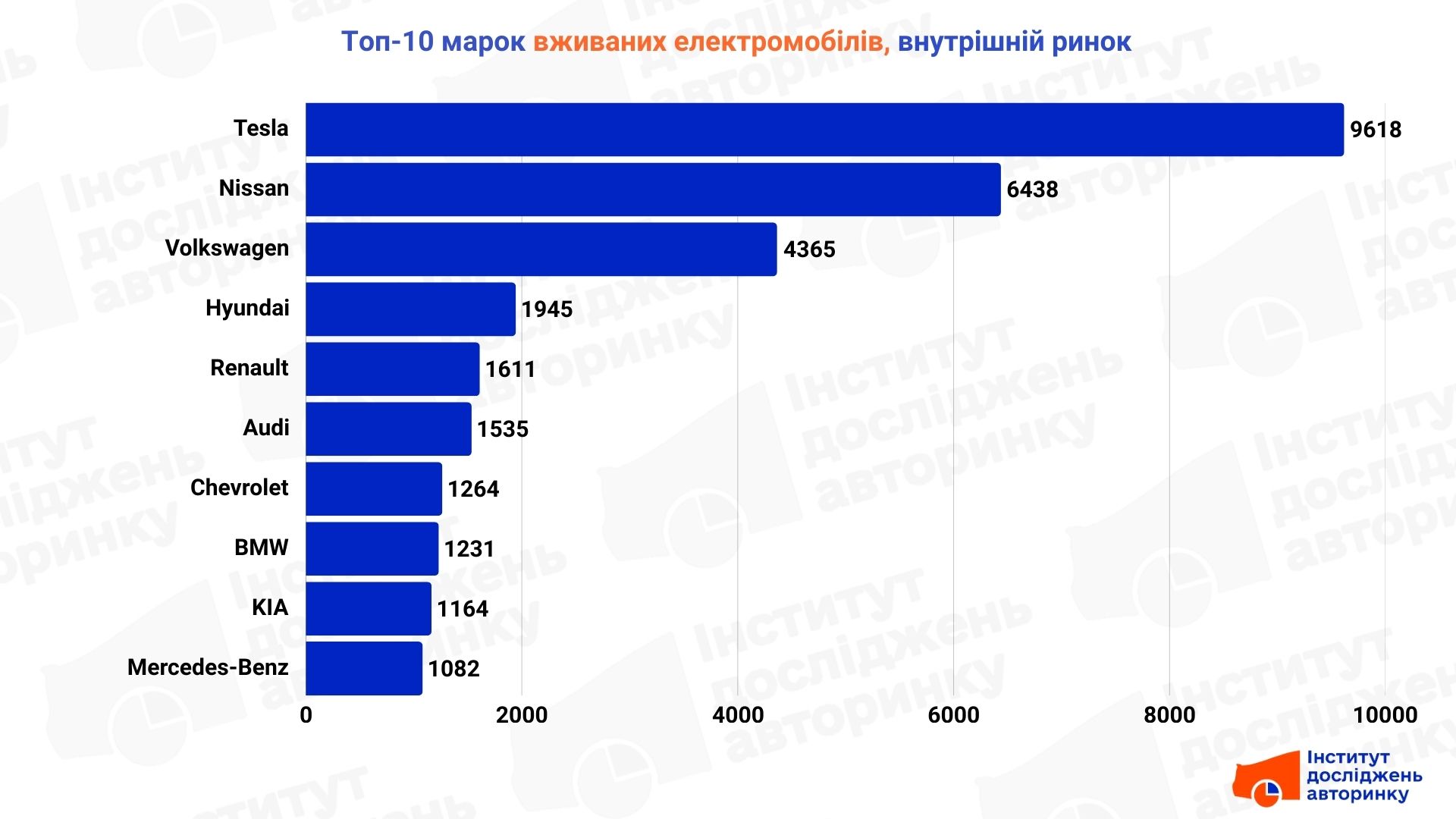
In the ranking of manufacturers in the domestic market, the picture looks more conservative than in the segment of "freshly driven". The undisputed leader remains Tesla, which confidently holds the first place. This is logical: cars imported a few years ago are now actively changing owners within the country. Second place goes to Nissan, whose result is ensured by a huge fleet of used Leaf. The top three is closed by Volkswagen, which is equally popular in both electric and traditional versions.
Next on the list are Hyundai and Renault, followed by the premium segment represented by Audi, BMW and Mercedes-Benz. Chevrolet and KIA are also in the top ten. An interesting nuance: the BYD brand, which became the absolute winner among new cars in 2025, is still only in eleventh place in the domestic market. This is quite understandable — these cars are too fresh, and their first owners are in no hurry to say goodbye to them yet.
Models
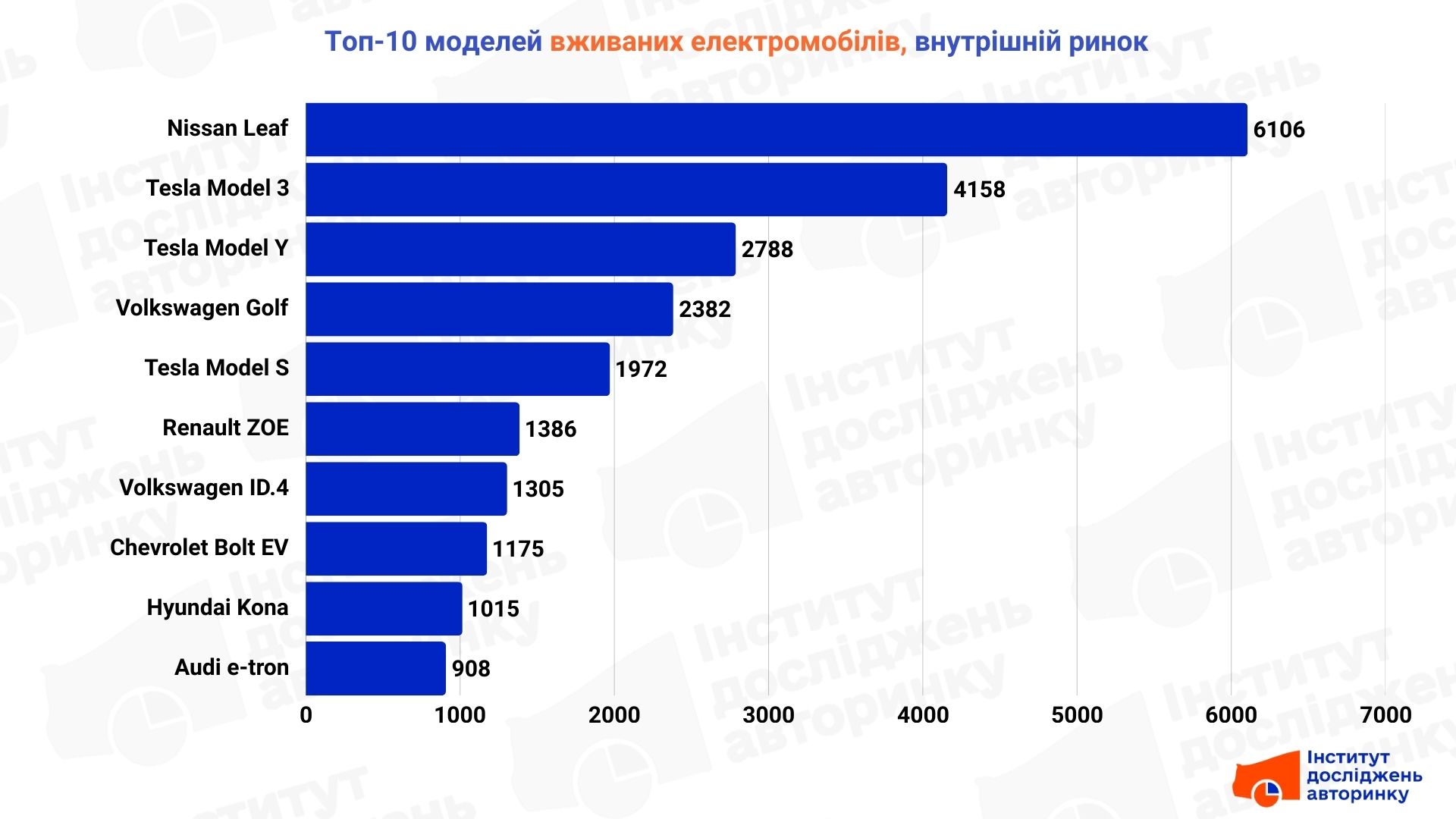
The Nissan Leaf still dominates the model ranking. Despite its age and competition, it remains the most popular electric car in Ukraine on the domestic market. However, the Tesla Model 3 and Model Y are already breathing down its neck, taking second and third places, respectively.
The fourth place was taken by the electric Volkswagen Golf, and the classic Tesla Model S closes the top five. The second half of the top 10 is occupied by the compact Renault ZOE, the modern Volkswagen ID.4 (which is already being squeezed out by the ID. Unyx in imports), the practical Chevrolet Bolt EV, as well as the Hyundai Kona and Audi e-tron. This is the very backbone that forms todayʼs "electric" mobility of Ukrainians.
Expert opinion
Ostap Novitsky, car market analyst (IDA):
“The domestic secondary market for electric cars still remains the smallest subsegment — in December it occupied only 17%. But it seems that this was the last time. Instead of the rapid replenishment of the fleet from abroad, which we saw last year, now we will observe an “overflow” of freshly imported and new cars into the domestic market. The “December impulse” will also add its weight, when more than 30 thousand cars were imported. Many of them were brought by dealers, hoping to sell them profitably with VAT, which they managed not to pay.
With a rough estimate of the active passenger car fleet at 6.5 million cars (although there are over 11 million in the registers), our 250 thousand electric cars are not making a global splash yet. Many owners will want to keep their cars — especially those who "pushed" the purchase to December so as not to overpay 20%. What about prices? Currently, as we predicted, they are only growing. But excess supply will inevitably lead to competition. In half a month we will see on the IDA price cut where the line has gone — up, down or is still on the horizon.
Memories from the garage: The first electric "dinosaurs"
While everyone is discussing software updates in the new Zeekrs and scolding Tesla for disabling Premium Connectivity, in the domestic market in 2025, real artifacts were changing owners — electric cars from the era when the very idea of driving "on batteries" seemed strange and expensive. We are not talking about modern conversions or garage DIYs, but about factory-produced electric cars from the late 90s — early 2000s, created long before the current EV boom. Here are a few examples:
- Toyota RAV4 EV (first generation, 1997—2003)
A real exclusive. The first generation of the electric crossover, which Toyota produced in limited editions, mainly for California as part of environmental programs. Nickel-metal hydride battery, electric motor with a capacity of about 50-60 kW, range of up to 150 km — indicators that at the turn of the millennium seemed almost fantastic. Today, seeing such a RAV4 in Ukrainian registers is like meeting a living mammoth that has also arrived on its own.
- Citroën Saxo and Peugeot 106 Électrique (1995—2003)
French twins from the era of NiCd batteries and a sincere belief in urban electric transport. Electric motor with a capacity of 20–27 kW, a range of about 80–100 km, maximum speed — up to 90–100 km/h. These were completely factory-produced models that were actually sold and operated, mostly by municipalities and enthusiasts. No romance of startups — only engineering stubbornness and government programs.
- Renault Kangoo Electrique (early 2000s)
A pure electric car, without gasoline crutches and hybrid compromises (and this is not the Kangoo ZE that we often see now). It had a NiCd battery, an electric motor of about 44 kW, a utilitarian format and a clear understanding of the target audience. In those years, the Kangoo Electrique was more of a tool than a toy — for services, delivery, urban use. Serial, factory-made, constantly busy.
- Daihatsu Cuore EV (1988)
The most mysterious exhibit in this company. In the late 80s, Daihatsu experimented with electric versions of the Mira/Cuore for the domestic Japanese market and public utilities. Lead-acid batteries, a meager range and almost zero chance of surviving to this day without a deep reconstruction. However, it found its new owner in 2025.
All of these cars were born at the same historical moment — the late 90s and early 2000s, when the electric car was exotic, not mainstream.
- Elon Musk at that time was not involved in cars at all, but was selling Zip2 and building PayPal.
- Tesla as a company did not yet exist.
- BYD produced batteries and cheap cars with internal combustion engines, rather than dictating trends to the global auto industry.
- The Chinese auto industry has generally been associated more with tractors and replicas than with the electric revolution.
All these (and similar) cars, pioneers of the electric market, did not appear to become massive. And not to survive. Electric cars of the late 90s and early 2000s were an experiment at a time when the very idea of driving on batteries seemed like a strange whim of engineers, easily drowned out by the sound of a V8 and the availability of gasoline.
They were without color screens, autopilots, and thousands of horsepower. Just silence, heavy batteries, and honest range math. The Toyota RAV4 EV, the French Saxo and 106 Électrique, the electric Kangoo, the rare Daihatsu Cuore — they paved the way, but they didnʼt stay on it themselves.
The world has chosen a different future: loud, bright, with TV-like displays, dozens of speakers, and software more important than mechanics. New electric cars sell sensations, not limitations.
The fact that these cars have survived until 2025 and are still changing owners is not a trend, but a memory. They appeared only to disappear.
And thatʼs why the modern electric car became possible at all.
- Subscribe to the Telegram channel of the Auto Market Research Institute to receive information first, without advertising and spam.


