


It is worth looking at the gas station stele today, where the price of diesel is 90+ UAH/l, and then turning your gaze to the road, where in some places half of the traffic consists of electric vehicles, and a natural question arises: where are our battery-powered heavyweights? Why are trucks still spewing smoke into the sky, while passenger cars quietly rustle their tires? Letʼs analyze this "electrical node", where logic rests on economics, and physics — on common sense.
N1: Urban Logistics
Currently, a little more than 5 thousand electric trucks are registered in Ukraine. This is about 0.26% of the entire fleet of freight transport. The basis of the N1 group is the Renault Kangoo ZE, half of all electric ones. There are also a few Nissan e-NV200 vans, about 7 hundred, then, in small quantities, 100-150 units each, Mercedes-Benz E-Vito, E-Sprinter, Peugeot Partner, Expert. There are even fewer others.
Itʼs hard to call it "popularity" while there are over 50,000 diesel Kangoos in the fleet. Rather, itʼs a purchase of a car for specific tasks, "start-stop" routes (courier or postal services) or short-distance trips. Or an attempt to enter the electric segment among the first, consciously agreeing to the restrictions on BEV transport.
N2 and N3: Heavy duty and light duty trucks
In groups with a gross vehicle weight of over 3,500 kg, electric vehicles are generally exotic — only about 200 units. You can list them in a few seconds: the list is formed by Ford Transit (67 units) and Tesla Cybertruck (51 units). Yes, this stainless triangle from Elon in Ukraine is included in trucks, and to drive it you need a category "C", because its gross weight exceeds the limits established by us for passenger cars and category "B".
There are also several Iveco Daily (23 units), Ford F-150 (18 units, again a pickup truck more likely for private use), Chanje V8070 (18 units, a real van), Rivian R1T (13 units, again a pickup truck for entertainment), and various others, in the amount of less than 10 units of each model,
With a truck fleet of approximately 2 million vehicles, 200 of which are pickup trucks, a third of which are trucks, is like a statistical error, but by no means an independent phenomenon.
Tractor units: Five Desperate Men
There are only five tractors for the entire country. And they are all Chinese, like SANY or Sinotruk.
And again, this number is more of an experimental format, not a trend towards electrification in the segment. Nominally, there are, but the chances of seeing them on the road are almost zero.
What in the world? Electrical price list
Ever since the electric car “movement” began, we’ve been hearing about the release of real electric trucks. But so far, we’ve mostly just heard about it. Tesla has long promised a mass release of the Semi, but so far it’s only selling test versions to select customers. There was the Nikola project, but they only managed to release a few beautiful videos of the truck rolling down a hill on its own, and then got involved in court cases because the investors’ money disappeared and the company went bankrupt.
There are real projects, and some of them can even be bought if you have the money and an irresistible desire to have something big on batteries. Here is an example of how much they ask for in Europe for trucks of different classes:
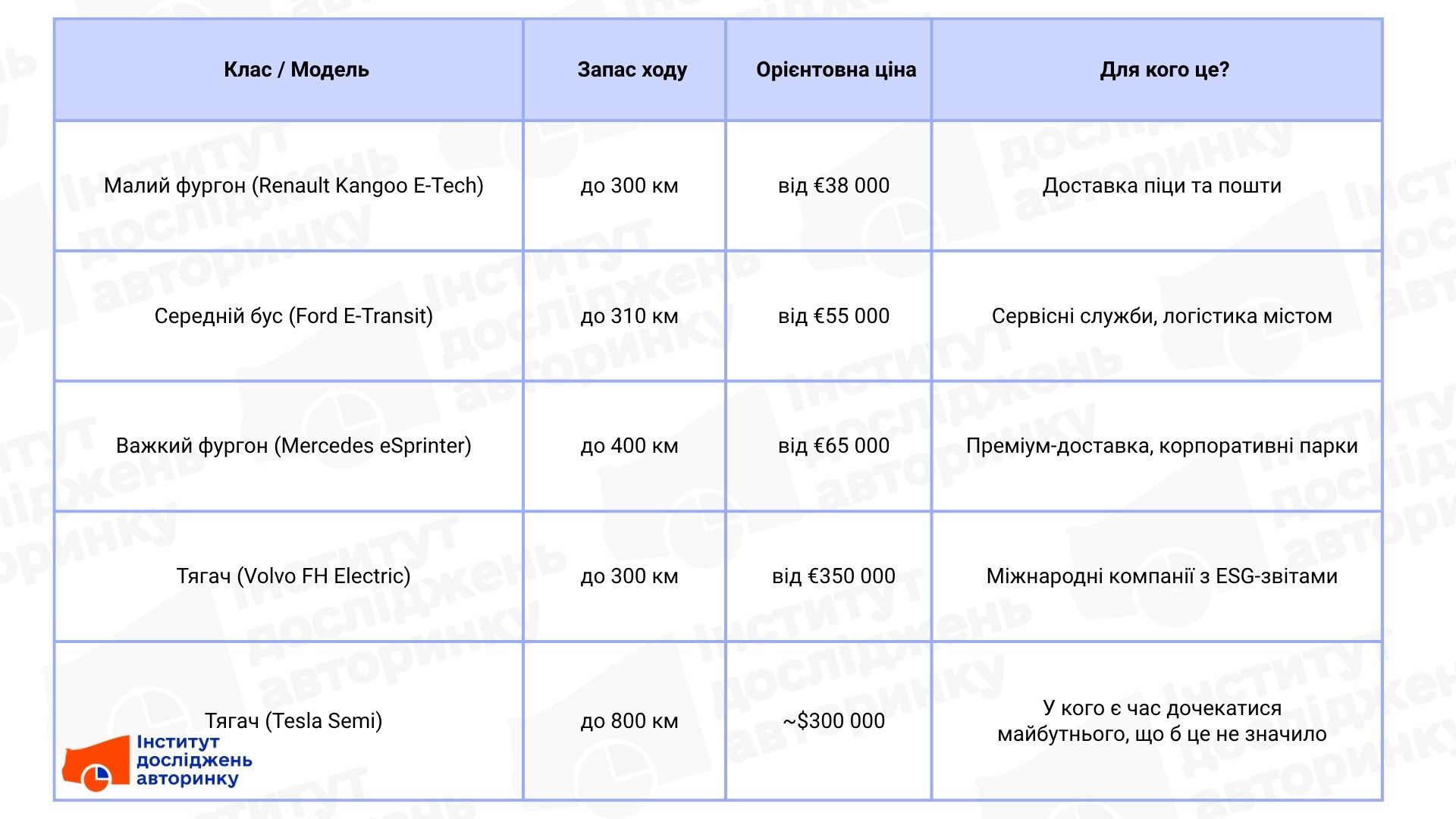
European brands (DAF, Mercedes, Volvo) make cool things, but the price of such a tractor is like three or four top-of-the-line diesel trucks. This is mathematics that does not yet converge without huge government subsidies.
Comment
from IDA co-founder Ostap Novytsky:
Todayʼs Ukrainian electric truck market is somewhat reminiscent of the electric car market of a decade ago. Everyone is looking, some want it, but only a few buy it.
And here it is important to understand — in 10 years nothing will change, maybe in 20 too. Because there is a significant difference between the passenger car segment and the freight segment. In logistics, every kilogram is money.
- Battery weight: If your battery weighs 3 tons, you are carrying 3 tons less cargo (in a Tesla Semi, the weight of the batteries can reach 4-5 tons). This is a minus for earnings.
- Battery life/price: In the commercial sector, the car “lives” on the road, not parked under the office. The battery will run out many times faster than in your Tesla at home. A million kilometers for a private car is a record, for commercial vehicles it is the calculated norm for the first owner for a 5-year lease period.
- Entry price: Buying an electric tractor today is like investing in the development of a spaceship. Or at least like investing in 2-3 classic diesel "trucks." Itʼs noble, but you have to calculate the payback very carefully.
- Downtime - everything here is tied to the tachograph and schedules. Charging stations must be easily accessible for large vehicles, in sufficient numbers, and with a large (in fact — incredible) capacity of about a megawatt. And this is a serious challenge for both the energy infrastructure and even for generation.
At the same time, the price per kilometer of electric trucks, according to various sources and calculations, remains lower than that of diesel counterparts. But even more conditions arise here: what is the price of energy, what is the cost of replacing the battery, how much does the "excess weight" of the battery in a particular model affect the total weight (after all, there is no internal combustion engine and its "bundling", fuel tank, etc.).
There are certain solutions, but again, they are isolated and not systemic. Quick replacement of a "container" with a battery, but this requires infrastructure (cranes, warehouses, stationary charging stations, operators) and is possible only on certain routes, and within the framework of one owner, so that there is no speculation with worn-out batteries. There are ideas for trailers with their own drive and battery — they will be able to push the tractor, and work as a hybrid auxiliary power unit, or autonomously. However, here too, the question arises of standardizing control protocols and tires, handling and safety on slippery surfaces, and the same weight, resource, price of such a trailer with a drive. Although the idea of "charge while you unload and load" is not so bad.
Obviously, for all this to change and reach a new qualitative level with a minimum of compromises, it is necessary for engineers to invent a fundamentally new source of energy storage. Easier, smaller, with a longer resource, with fewer “whims” regarding temperatures, charge levels, and with an adequate price. The demand is high, work is underway. It is known that inventions do not happen just “because they really need it” — itʼs like inventing electricity and a light bulb on demand, because itʼs dark. And therefore, predicting the time when this is likely to happen is about the same as predicting the day of Mars colonization.
In some countries, these fleets are larger, and an electric tractor on the road is not such an exotic thing, but this is more the result of government subsidies and decisions by wealthy corporations to implement "green" plans, rather than mass financial models.
The world is waiting for a technological breakthrough, and it is ready for it. When it happens, we will start looking at diesel trucks in the same way we look at steam tractors now: with curiosity, respect for the past, and the understanding that it is history. And until then, in the commercial "long-range" and heavy-duty sector, diesel will remain the basis of fleets.
- Need more information about car markets? Order it from IDA!


