


Experts from the Institute of Auto Market Research analyzed vehicle registration statistics in Ukraine and identified the most popular models in three segments of trucks weighing over 3.5 tons (except for tractor units) : used imports, domestic resales, and purchases of new cars, including those converted in Ukraine.
Truck market dynamics
The market volume of trucks with a gross weight of over 3,500 kg as of November 2025 amounted to 1,754 units. Compared to October of the same year, this is 11.8% less, and also 6.1% less compared to the results of November 2024. Monthly volumes are shown in the diagram.
- Check the history of a car by VIN code before buying using the CEBIA service!
The structure of this segment is as follows: 73.4% (1287 units) — domestic resales, 13.2% (232 units) — imports of used trucks; 3.1% (54 units) — imports of new trucks, 10.3% (181 units) — sales of trucks manufactured (or converted in the factory) in Ukraine. The total share of new vehicles in this group was 13.4%.
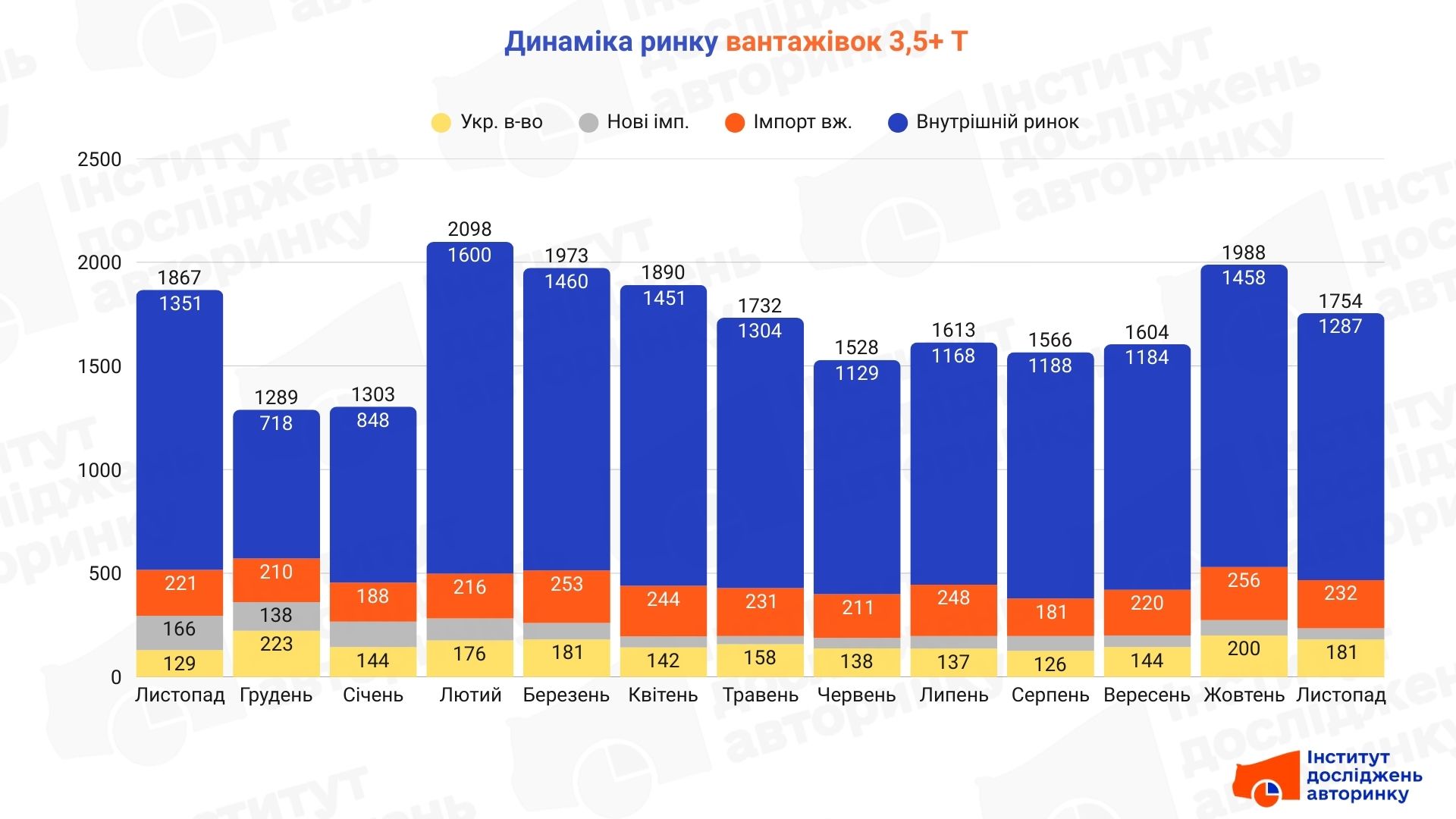
The dynamics by individual subsegments, the shares of which were just given, are as follows:
- Domestic resales: −11.7% MM, −4.7% YY
- Used imports: −9.4% MM, 5.0% YY
- New imports: −27.0% MM, −67.5% YY
- Made in Ukraine: −9.5% MM, +40.3% YY
Top 10 trucks in the domestic market
The most popular type in this subsegment was dump trucks, with stable demand for vans and refrigerated vans.
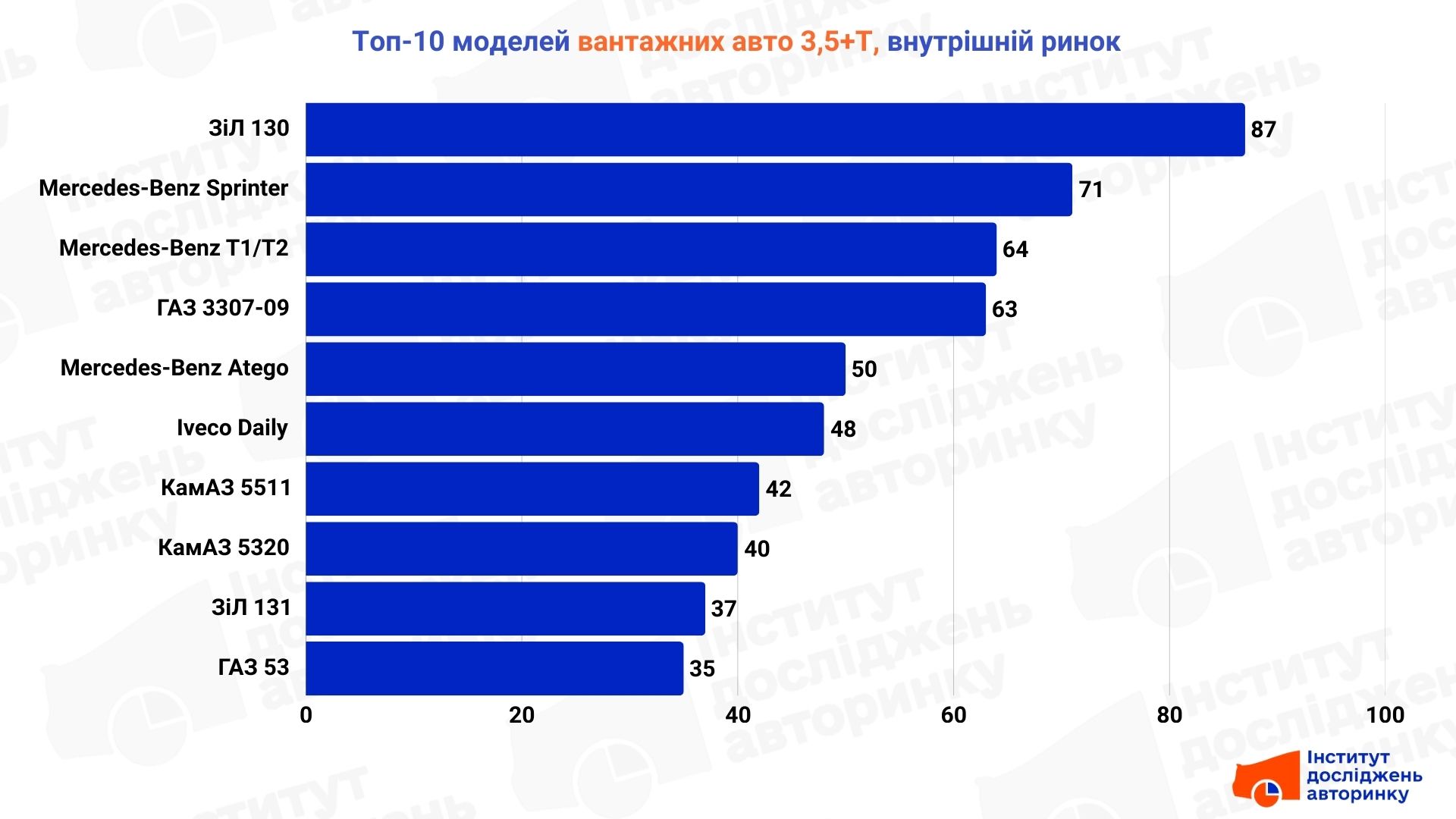
The ranking of the most popular used trucks (over 3.5 tons) on the domestic market is more like a list of exhibits in a technical museum than a report from a European country. Here, modern logistics is forced to share the road with equipment that still remembers the times of "stagnation".
The ranking is topped by an absolute survival phenomenon — the ZiL-130. This truck, developed in the 1950s, continues to be the best-seller of the Ukrainian secondary market in 2025. The secret is simple: it costs less than a new iPhone, and you can fix it with a blow of a sledgehammer. True, its fuel consumption is such that it seems to consume gasoline even with the engine off. But for short trips in the countryside or on construction sites, it still has no equal in price.
In second place, trying to bring some common sense into this chaos, is the Mercedes-Benz Sprinter. These are the heavy versions of this model, which fall into the truck category. Also in the top are two more representatives of the German auto industry:
- The legendary Mercedes-Benz T1/T2 are the square "grandfathers" of modern Sprinters, which seem to be made of the same "liquid" metal as the Terminator itself.
- The more modern Mercedes-Benz Atego is perhaps the only fully modern mid-size truck on this list, looking like an alien from the future.
- They are joined by the Italian workhorse Iveco Daily, which fills the niche of light delivery trucks.
The rest of the positions in the top ten were densely occupied by the ghosts of communism. Here are the "lawns" — GAZ-3307/09 and the ancient GAZ-53, which still carry firewood and grain, scaring environmentalists with their exhaust. Here are the heavy trucks of construction and fields — KamAZ-5511 (dump truck) and KamAZ-5320 (flatbed). They are bought not because of the good life, but because an imported dump truck costs dozens of times more. And the parade of rarities is closed by the ZiL-131 — an all-terrain monster with three axles, which is most often bought by foresters or well drillers, because where it goes, there are basically no roads.
Top 10 imported trucks with mileage
Most often, the Ukrainian fleet last month was replenished with tail lift vans, regular vans, and container trucks.
- Looking for a way to "drive" a truck from Europe? — West Auto Hub will help you get it turnkey!
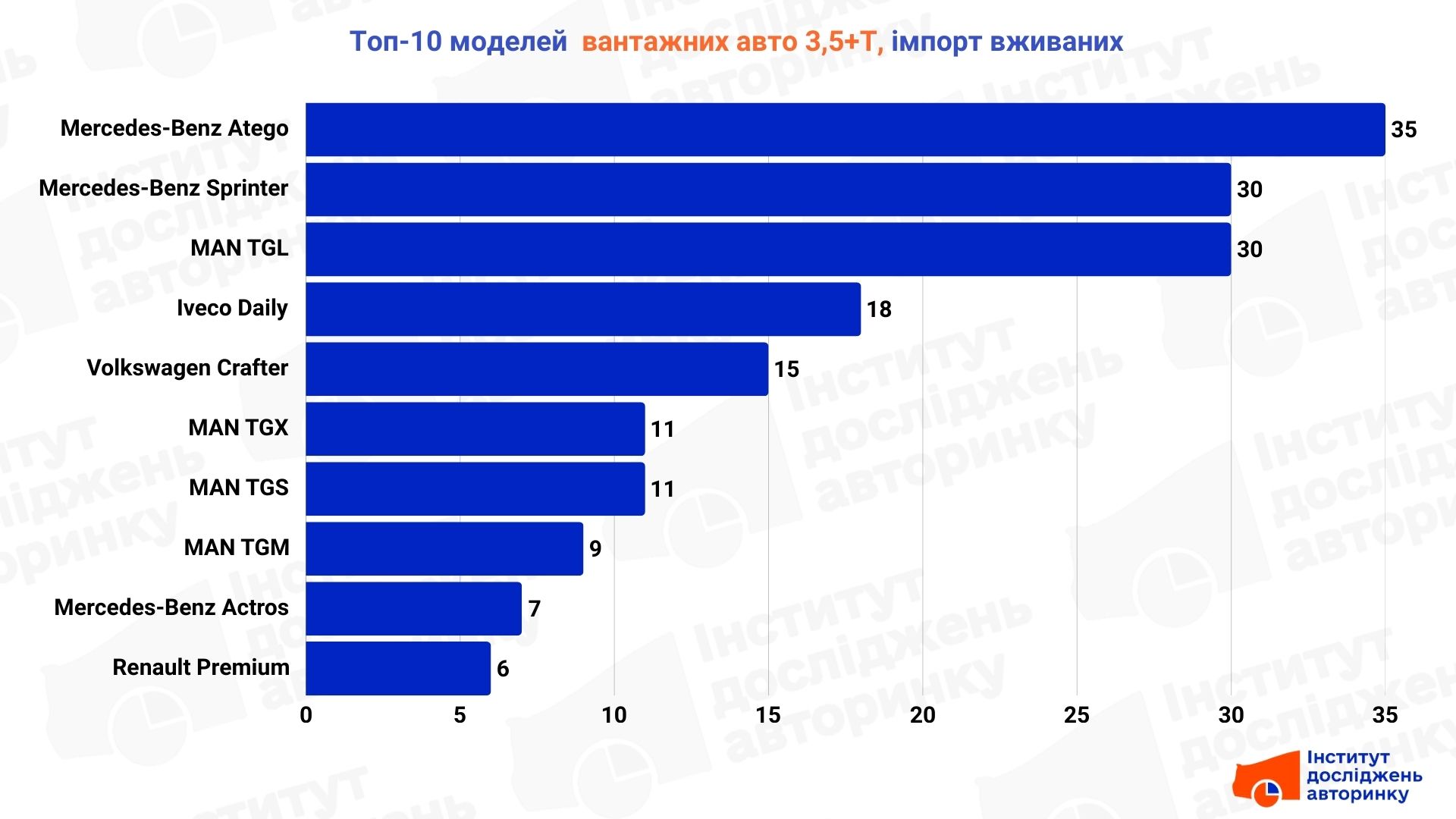
If the domestic market resembles an exhibition of achievements of the Soviet economy, then the list of imports is a showcase of German engineering. Ukrainian business, choosing equipment for long-term work, votes with its wallet exclusively for reliability. There are practically no random guests in the Top 10 — almost the entire rating was divided between two giants: Mercedes-Benz and MAN.
The list of imports is headed by the standard of the delivery truck — Mercedes-Benz Atego. This is the ideal choice for regional logistics: to deliver goods from the distribution center to the supermarket. A reliable, simple and liquid machine. Right behind it is the direct competitor MAN TGL. They go hand in hand, closing the segment of medium-tonnage transportation. Business buys them en masse, because it is the main tool of retail.
A significant part of the rating is occupied by models that visually resemble ordinary "buses", but technically (due to the total weight of more than 3.5 tons) fall into the cargo category. Here we see the Mercedes-Benz Sprinter (heavy series with paired wheels at the rear), Iveco Daily and Volkswagen Crafter. They are chosen by those for whom a regular van is not enough, and a full-fledged truck is still too big.
An interesting phenomenon of November is the incredible concentration of the MAN brand in the top. In addition to the aforementioned "baby" TGL, the list includes the entire line of the manufacturer, the TGX, TGS and TGM series.
They are accompanied by a few representatives of other brands: the flagship Mercedes-Benz Actros and the only "Frenchman" who managed to break into this German crowd — Renault Premium.
Top 10 new trucks
In this subsegment, the greatest demand was for tail lift vans, dump trucks, and classic vans.
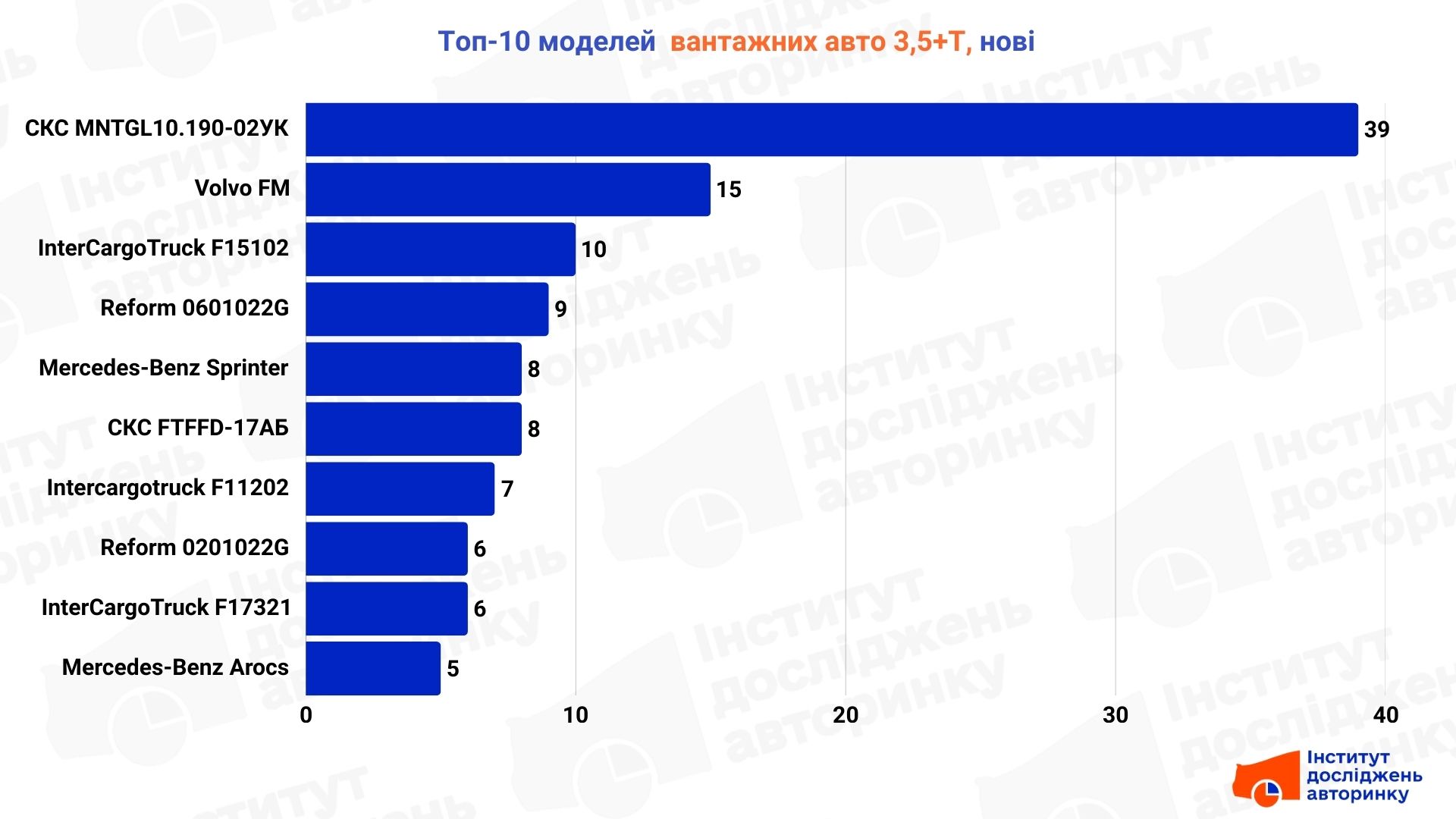
The market for new trucks (with a gross weight of over 3.5 tons) looks the most encrypted. If you look at the top 10 models, half of them resemble complex Wi-Fi passwords, not car names. This is explained simply: the lionʼs share of new equipment is already registered as a product of Ukrainian production. Imported chassis (MAN, Ford, Iveco, etc.) are retrofitted with a body, a crane-manipulator or a van at domestic enterprises ("Spets-Kom-Servis", InterCargoTruck, Reform), receiving a new name and Ukrainian VIN code.
The first place is taken by a large margin by the model with the complex name SKS MNTGL10.190-02UK. Behind this set of letters is the popular German MAN TGL chassis, which was retrofitted by the company "Spets-Kom-Service" (Polycar). In fact, the leadership of this "Ukrainian MAN" confirms the trend that we saw in the import of used cars — business is now massively buying medium-tonnage equipment for distribution, but in the case of new cars it prefers ready-made "turnkey" solutions from a local manufacturer.
Among this set of special equipment, only three "purebred" factory models have made their way, which are sold under their own brands:
- The Volvo FM is Swedenʼs best-selling truck, ranked second. Itʼs the choice of large companies for serious work.
- The Mercedes-Benz Sprinter is a heavy-duty version of the popular van.
- The Mercedes-Benz Arocs is a powerful construction vehicle designed for tough operating conditions.
The remaining positions in the ranking are occupied by various variations from Ukrainian developers:
- InterCargoTruck is a company represented in the top by three different indices (F15102, F11202, F17321). These are specialized vans, often isothermal or industrial, built on various imported chassis.
- Reform is another well-known Ukrainian manufacturer, whose two models made it to the list of leaders. Usually these are special transport (armored cars, collectors or medical equipment) based on light trucks.
- Another model from SKS (based on Ford Trucks or Foton) also made the top ten.
Expertʼs comment
Stanislav Buchatsky, Head of the Institute for Car Market Research:
"The market for trucks weighing more than 3.5 tons now resembles three parallel realities that almost do not intersect. The domestic market is a "survival economy". The fact that in 2025 the ZiL-130, developed 70 years ago, remains the sales leader is a diagnosis of the financial condition of small businesses in the regions. Farmers and builders are forced to buy what is cheap "at the start", turning a blind eye to the crazy fuel costs. This is a museum on wheels that works not "thanks to", but "in spite of".
Importing used cars is an "economy of efficiency." Here, business does not consider the purchase price, but the cost of ownership. The total advantage of Mercedes-Benz and MAN proves that Ukrainian carriers are not ready for experiments — they need predictable German reliability for daily work.
And the new car market is an "economy of special tasks". The fact that in the top sales we see not so much global brands as complex indices of Ukrainian enterprises (SKS, Reform, InterCargoTruck) indicates an important trend. Business buys not just "chassis", but a ready-made tool — a grain truck, a refrigerator or a manipulator, manufactured in Ukraine on an imported basis. This is a sector of professional "turnkey" solutions.
Garage artifacts
Notes from registrations and real-life technology
Ostap Novitsky
"Processing the Big Data arrays of the Ukrainian car market, we often see just numbers. But sometimes the matrix fails and throws out real artifacts. In November 2025, two 1966 trucks found new owners. Just think: these are cars produced in countries that no longer exist on the world map.
Lot #1: "Greetings from the GDR" — Blue IFA W50 dump truck. Production of the W50 model in the city of Ludwigsfelde started only in 1965. That is, this "blue workhorse" is one of the early batches, perhaps a representative of the first hundreds that came off the assembly line then! This car remembers the still young Berlin Wall. Under its wheels, the "socialist paradise" of East Germany was being built, accompanied by cheerful German marches, and in the cabin, perhaps, the driver quietly tuned the radio to some Western wave to catch the Beatles, who released their Revolver in 1966. The GDR disappeared, the Wall fell, and this IFA started up again in November 2025, repaired the body and went to work somewhere in the Ukrainian hinterland.
Lot #2: "MAZ, which moved the hood into the past" — Flatbed MAZ-500. For 1966, it was space. The first mass Soviet hoodless truck! Drivers then looked at it like a UFO: the engine under the cab, panoramic glass, sometimes a sleeping place (luxury!). 1966 is the Brezhnev era that was just beginning. This MAZ could carry materials for the construction of the Kiev Hydroelectric Power Plant or panels for the first "Khrushchevs". It survived the "stagnation", Perestroika, the collapse of the Union and the stormy 90s.
These cars are not about nostalgia or myths. They are about engineering that did not pretend to be anything more than it was. Countries disappeared, borders changed, ideologies were rewritten, and 59-year-old MAZs and IFAs simply changed owners and moved on. Without legends, without updates and without promises of a “new era”. Because metal does not know slogans. It knows the load.
- Subscribe to the Telegram channel of the Auto Market Research Institute to receive information first, without advertising and spam.


