


The bus market in 2025 became a platform for major changes: while the domestic market "sagged" in terms of volumes, the import and new equipment segments demonstrated confident growth. This indicates a gradual, albeit difficult, transformation of passenger transportation in Ukraine.
2025 Results: Renewal Despite Challenges
The overall picture of the year looks like an attempt by businesses and communities to move away from old schemes towards more predictable solutions:
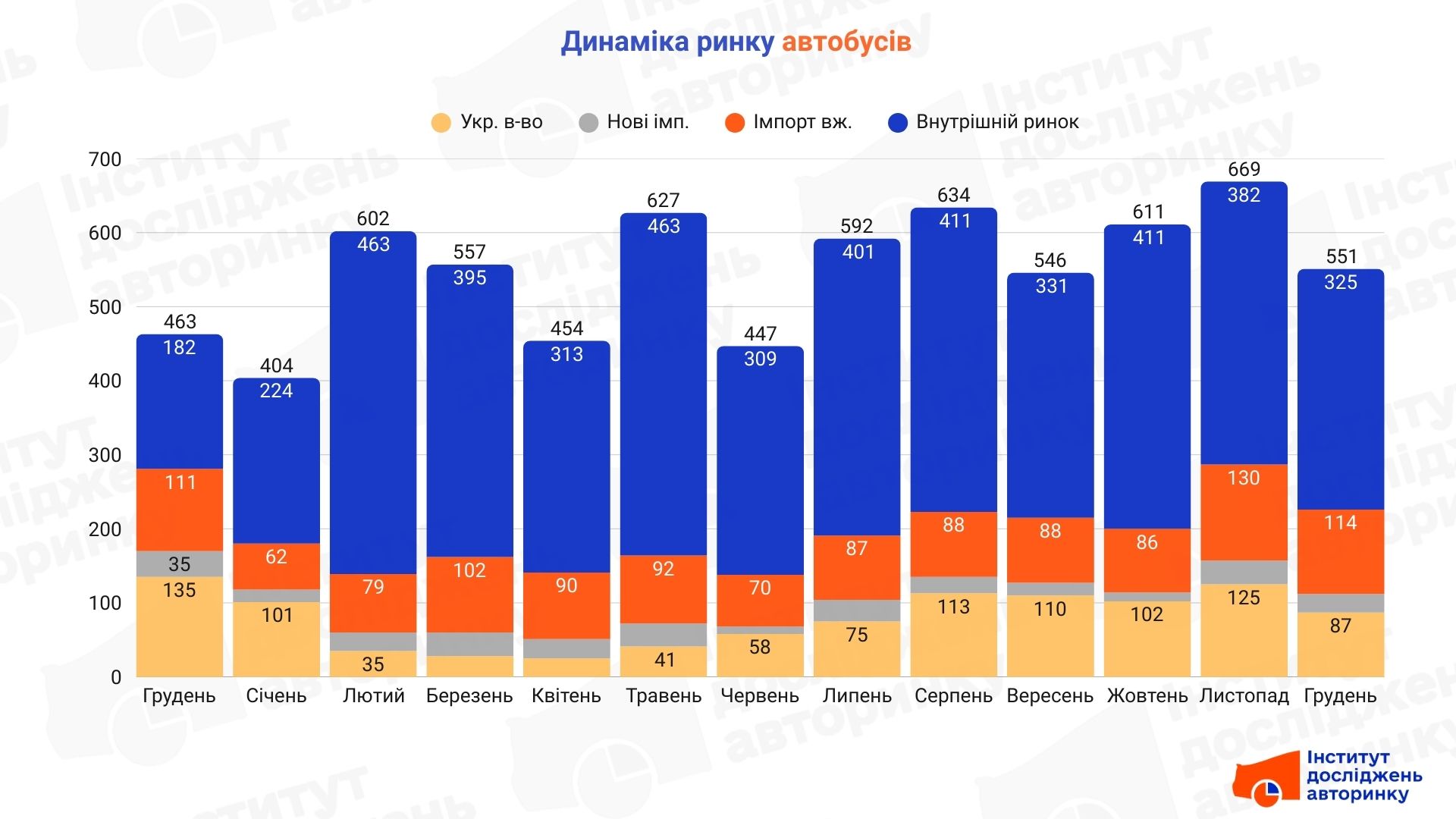
- Domestic market: 3,978 transactions were recorded. This is a significant drop of 36.1% compared to 2024. It seems that the resource of "transferring" old cars between owners within the country is gradually being exhausted.
- Import of used vehicles: Here we see a positive trend — 1,088 registrations, which is 31.7% more than the previous year. This is “fresh blood” for our roads, mainly from Europe.
- New buses: The most optimistic segment is 1,176 units, a 15% increase. This indicates that municipal and school procurement programs continue to operate.
December results
The end of 2025 brought the traditional slowdown in activity before the holidays. Most indicators show a decline compared to November ( MM ). In particular, production and assembly in Ukraine sank by 30.4% per month.
However, if we look at the dynamics of YY (until December 2024), we see a growth in domestic resales of 78.6%. This is the already familiar "recovery" effect after technical failures in the registers of the Ministry of Internal Affairs at the end of the year before last.
In total, in the last month of 2025, 325 purchase and sale agreements were concluded on the domestic market, 114 first registrations of used buses and 112 new ones were made (of which 25 were imported, 87 were produced in Ukraine).
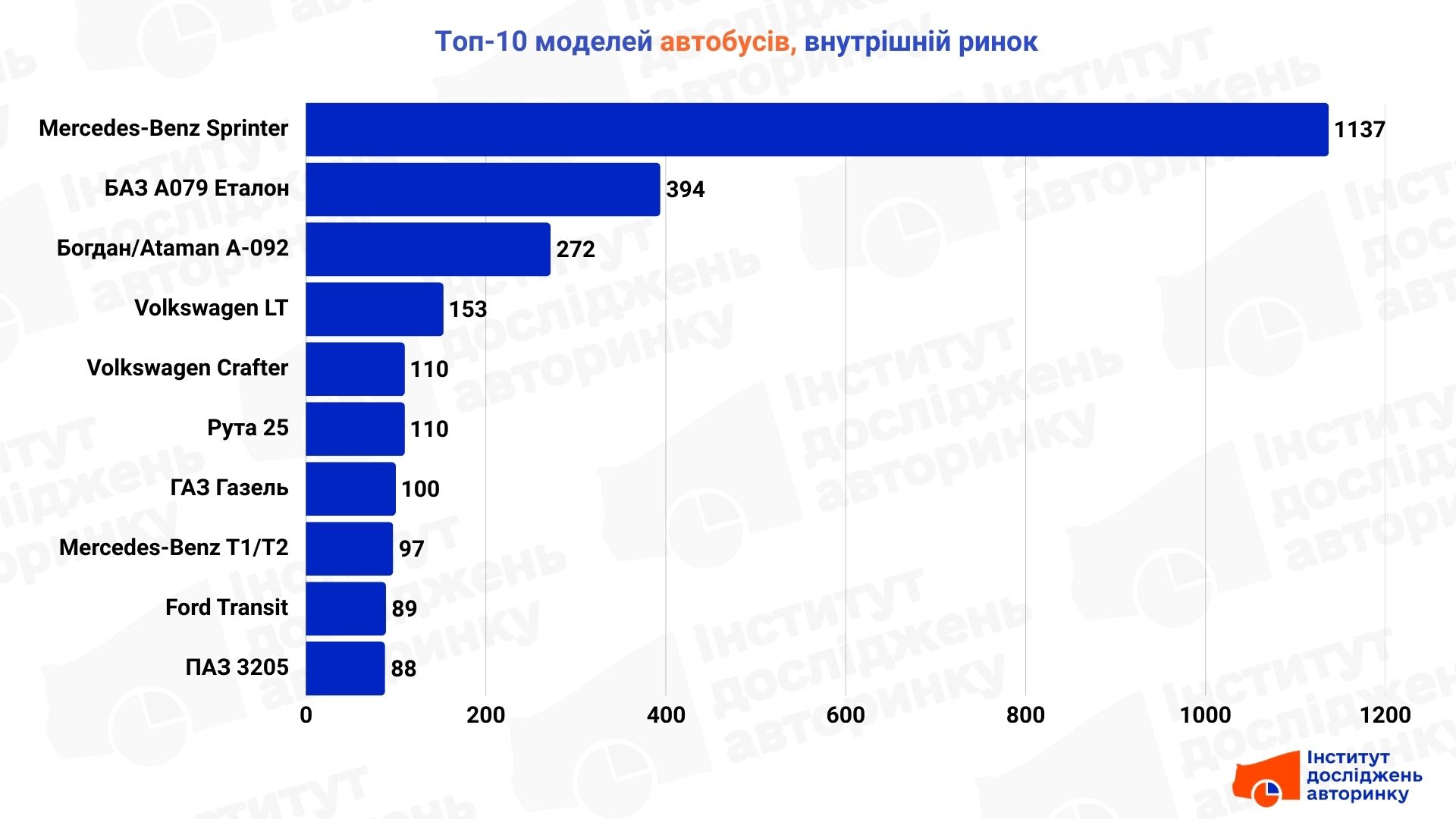
The most popular buses on the domestic market
The Mercedes-Benz Sprinter dominates here — the absolute leader in terms of the number of deals. Next to it are the Ukrainian BAZ A079 Etalon and Bogdan/Ataman A-092.
The level of endurance of the equipment of past eras remains interesting. Despite the year 2025 on the calendar, the PAZ 3205 and GAZ Gazelle are still present in the rating. It seems that these models have the ability to exist in the registers despite any standards of comfort. Also, representatives of the Volkswagen LT and Mercedes-Benz T1/T2 lines are steadily changing hands — equipment whose life cycle turned out to be much longer than the manufacturers expected.
- Check the history of a car by VIN code before buying with CEBIA!
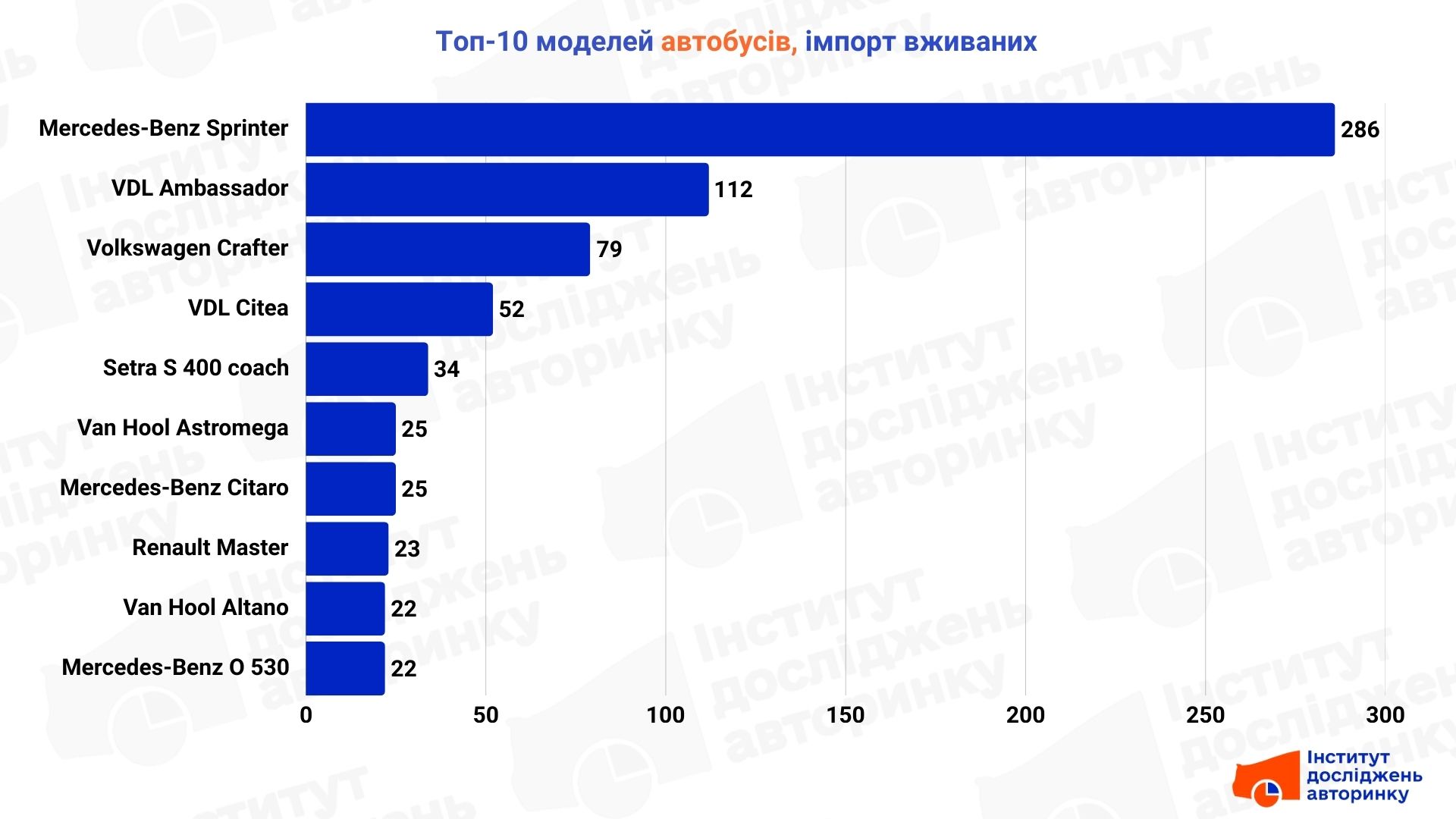
The most popular used buses imported from abroad
In this segment, the emphasis is shifting to comfort and large capacity. In addition to the ubiquitous Sprinter, carriers are actively importing:
- Dutch VDL Ambassador and Citea — for city routes.
- Premium liners Setra S 400 and Van Hool Astromega — for intercity flights.
- City Mercedes-Benz Citaro and Renault Master.
This import is the main tool for displacing morally outdated models from city streets.
- West Auto Hub will help you deliver the bus from Europe, clear customs, certify and register it .
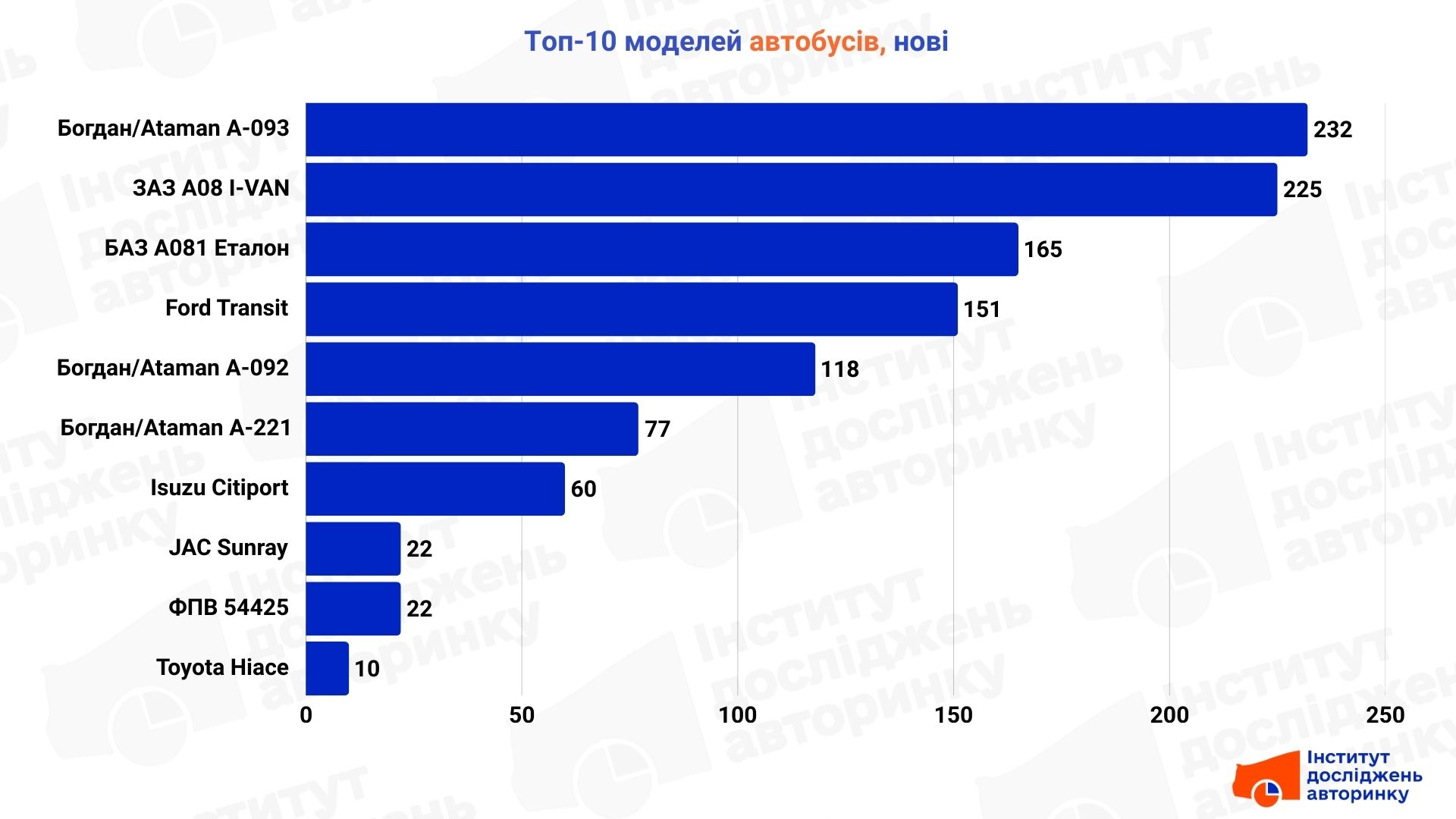
The most popular new buses
The new car market is almost entirely owned by Ukrainian enterprises, which is due to tender purchases for schools and cities, as well as the specifics of competitions for scheduled transportation.
- Bogdan/Ataman (models A-093, A-092, A-221) and ZAZ A08 I-VAN form the core of registrations.
- The BAZ A081 Etalon and Isuzu Citiport cover the needs for medium and large capacity.
- JAC Sunray and Toyota Hiace are also appearing, catering to the needs of the small class.
Expert opinion
Stanislav Buchatsky, Head of the Institute for Car Market Research:
"The bus market in 2025 is clearly divided into two parts. The domestic segment is rapidly losing volume, as old equipment is finally failing. At the same time, the growth in imports of used European buses and the purchase of new domestic models are signs of the gradual professionalization of carriers. The presence of Gazelles or PAZs in the resale tops still remains a sign of the shortage of a quality alternative in some regions. However, the general vector for fleet renewal is already irreversible: the market chooses economic efficiency and more modern standards of passenger transportation."
Memories from the Garage
Auto expert Ostap Novytskyʼs column
The appearance of the next few cars in the 2025 registers is not just a legal fact, but a real journey through time. While modern manufacturers argue about the number of USB ports for passengers and the speed of satellite WiFi, these "iron witnesses" remind us of an era when a luxury was simply the absence of the smell of gasoline in the cabin, and not having snow blowing from somewhere in the winter.
- ZIL-118 (1976): not a bus, an actor
ZIL-118 "Yunost" was not just a bus — he was an artist who happened to be born from metal, and not from an acting dynasty. Back then, even those who didnʼt remember their own neighbors in the driveway recognized him. Because he was everywhere.
In "The Caucasian Captive" it appears so naturally, as if it were not a movie, but his own tour along mountain roads. In "Ivan Vasilyevich Changes His Profession" it flashes in the frame, like a real official transport of the era, which cannot be unnoticed. In chronicles, documentaries, TV shows — it was everywhere where it was necessary to show something modern, prestigious, almost foreign, but still "ours". ZIL-118 transported artists, delegations, officials, sometimes even those who considered themselves more important than artists and delegations combined.
Inside, the smell of nail polish, new suits, and a faint sense that life might be a little better than it seemed from the window of an ordinary bus. The passengers sat straight, as if on an airplane, and thought about the future—bright, shiny, with big salaries and short queues.
ZIL listened to these thoughts silently, like an experienced psychotherapist, and rolled on, knowing that each of his flights was a small premiere.
- LAZ-695 (1975): a bus that knew all the cityʼs secrets
LAZ-695 was like a janitor who knew everyone in the neighborhood by name. He saw first dates, last shifts, morning quarrels, evening reconciliations. He drove people to work, to the market, to the sea, to weddings, and wherever else — and never asked unnecessary questions.
He had a special way of moving: he swayed a little, as if he was thinking about something important. Maybe why someone in the cabin always eats seeds. Or why passengers are always sure that they will make it to their destination on time, even when they run after him with a bag in their hand.
The windshield and the windows of the semi-cab were often draped with fringed curtains—someone once decided that a bus should resemble a living room. The fringe swayed over every pothole, as if applauding the road, and over time absorbed the dust, sun, and smells of hundreds of trips.
On the sun visors were amateur drawings. Mountain serpentines, palm trees, rivers that had never flowed near this route. They were drawn with whatever was at hand — gouache, oil, sometimes just paint from the nearest store. The lines were a bit crooked, the perspectives were questionable, but they had the main thing: the desire for the road to lead somewhere further than the next stop.
Under the driverʼs seat were greasy gloves, keys, a screwdriver, and a piece of wire that "might still be needed." This simple set reminded the bus that the driver was ready for any technical tricks he might need. And the driver that he shouldnʼt relax.
This LAZ was probably a bus that knew life from the inside. And if it could talk, it would tell such stories that we would have to make a separate season of the documentary. And it is officially the oldest bus, bought last year.
- PAZ‑672M (1978): "Pazik" that carried the country and our childhood
PAZ-672M never claimed fame. It rarely starred in movies, didn’t transport delegations, didn’t stand outside hotels with red carpets. It just worked. The way people who don’t know how to do anything else work.
It had round headlights that shone a little sadly, as if it always woke up earlier than everyone else. Small windows through which the world seemed neat, like in a childʼs drawing. And those legendary hatches on the roof — ventilation that worked only when the wind was in a good mood. And in general, it was made of minimalism — small doors with even smaller flaps, modest seats, a narrow passage, which was certainly liked by children who were taken in small batches to their grandparentsʼ for vacations. The driverʼs area alone with a warm hood on the side took up almost a third of the entire cabin. And the driving profession was valued differently back then.
The smell in the cabin was special: gasoline, BSC, dust from club backstage, a bit of rubber, a bit of old suitcases. This smell could not be confused with anything else — it smelled of life that was not in a hurry, but always moving forward.
The PAZ was as versatile as a Swiss Army knife, only Soviet. In the mornings, it would take lecturers to a village club, where a massive wooden tribune and stern-looking portraits stood on the stage. At noon, it would take workers to harvest apples, and the cabin would smell of autumn mixed with gasoline. In the evenings, it would take a funeral procession, and then the back door, created "just in case," would become part of a ritual that the bus accepted with the same humility as its morning trips. Or it would simply drive along the "district"-"village" route every day, never asking when asphalt would be laid here. Perhaps he even liked the light dust rising behind him from the field road, which was somewhat reminiscent of waves behind a cruise ship.
"PAZik" was not just a means of transport. It was a witness. It saw joys, losses, everyday life, holidays, tours, bazaars, weddings, funerals, first kisses, last hopes. It knew that life is not always beautiful, but always honest. And when it drove along the evening road, its low engine humming and springs creaking on the potholes, it seemed to be saying: "Hold on. Iʼll get you there. I always get you there."
Three buses, three personalities, three ways of looking at life. One is an artist, the second is a hard worker, the third is a traveler. And all three are part of our memory, our childhood, our roads that have long been overgrown with grass, but still lead in the right direction.
- Subscribe to the Telegram channel of the Auto Market Research Institute to receive information first, without advertising and spam.


