


The sharp increase in oil prices in the first and early second quarters of 2026 significantly changed the structure of operating costs for vehicle owners. The Institute for Automotive Market Research conducted a feasibility study of the cost of 100 km of mileage for various types of powertrains based on the universal platform of the Volkswagen Golf VII (Facelift, 2017—2020).
The choice of this model is due to the availability of factory modifications with gasoline, diesel, and electric power plants, as well as the popularity of versions with gas-cylinder equipment in our market, which allows minimizing the impact of structural differences in the body on the research results.
Calculation methodology
The assessment used real consumption figures in the combined cycle, not the manufacturerʼs passport data.
- Electric car (e-Golf) — 17.5 kWh/100 km
- The value includes Wall-to-Wheel losses, operation of battery thermal control systems and auxiliary systems.
- Gasoline (1.4 TSI) — 7.0 l/100 km
- Typical indicator for everyday use.
- Diesel (1.6 TDI) — 5.5 l/100 km
- Average value for the mixed cycle.
- LPG (1.6 MPI) — 10.5 l of gas + 0.4 l of gasoline/100 km
- The gasoline component takes into account engine warm-up and the operation of the afterburner system in real operating conditions. Note: for the LPG assessment, a conventional configuration with a 1.6 MPI naturally aspirated engine, typical of previous generations of the Golf platform, was used. This approach allows to maintain comparability of results and reflect the typical economy of operation of LPG cars in the mass segment.
Average energy prices (Ukraine, April 2026)
- Gasoline A-95 — 73 UAH/l
- Diesel fuel — 90 UAH/l
- Liquefied gas (LPG) — 49 UAH/l
- Electricity (household tariff):
- night — 2.16 UAH/kWh
- day — 4.32 hryvnias/kWh
- Public charging stations:
- AC — 21 hryvnias/kWh
- DC — 26 UAH/kWh
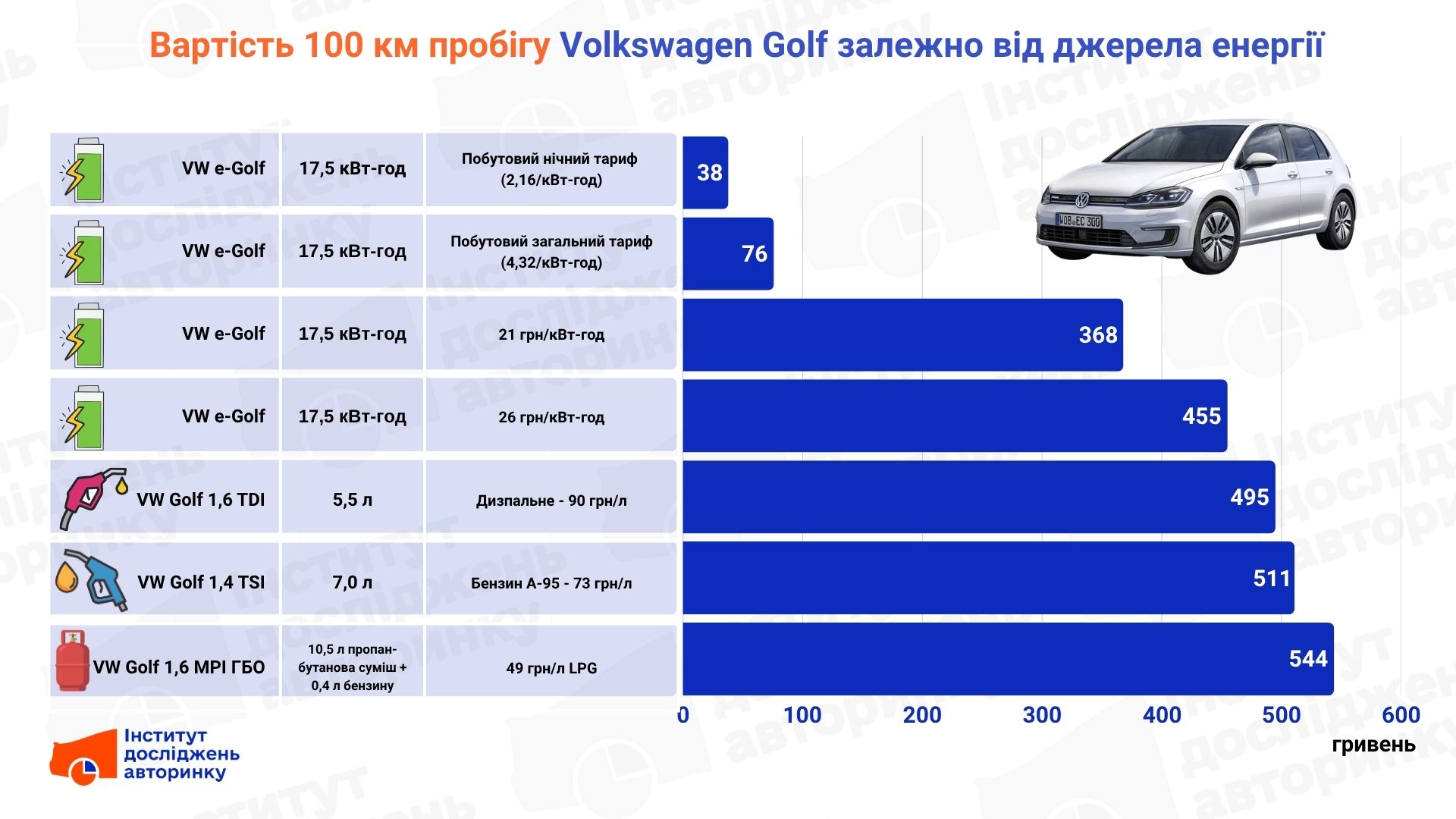
LPG: loss of economic advantage
At current prices, operating a car with LPG is no longer the cheapest option. The cost of running LPG exceeds that of gasoline and diesel engines, although the difference remains moderate. The economic feasibility of LPG in 2026 largely depends on the characteristics of the car, individual annual mileage and refueling conditions.
Diesel parity
The high price of diesel fuel has practically offset the advantage of low consumption. The difference in mileage between a diesel and a gasoline Golf is about 16 UAH per 100 km. Given the higher cost of servicing diesel systems, their feasibility in the private sector requires additional justification.
Electric vehicles: dependence on charging scenario
Electric vehicles remain the most economical mode of transport only if they have access to a household electricity grid, where the difference in mileage cost with an internal combustion engine is 12–14 times.
When using only public DC stations, the e-Golfʼs mileage comes closer to the price range of petrol and diesel cars, reducing the key economic advantage.
Study limitations
The calculation takes into account only direct energy costs. It does not reflect:
- depreciation and loss of market value;
- maintenance costs;
- insurance and taxes;
- wear of tires and consumables.
Result
In the current price realities of the Ukrainian market , the economics of car ownership increasingly depend not on the type of powertrain, but on the usage scenario. It is access to cheap energy, not technology per se, that determines the operational efficiency of transport in 2026.


