


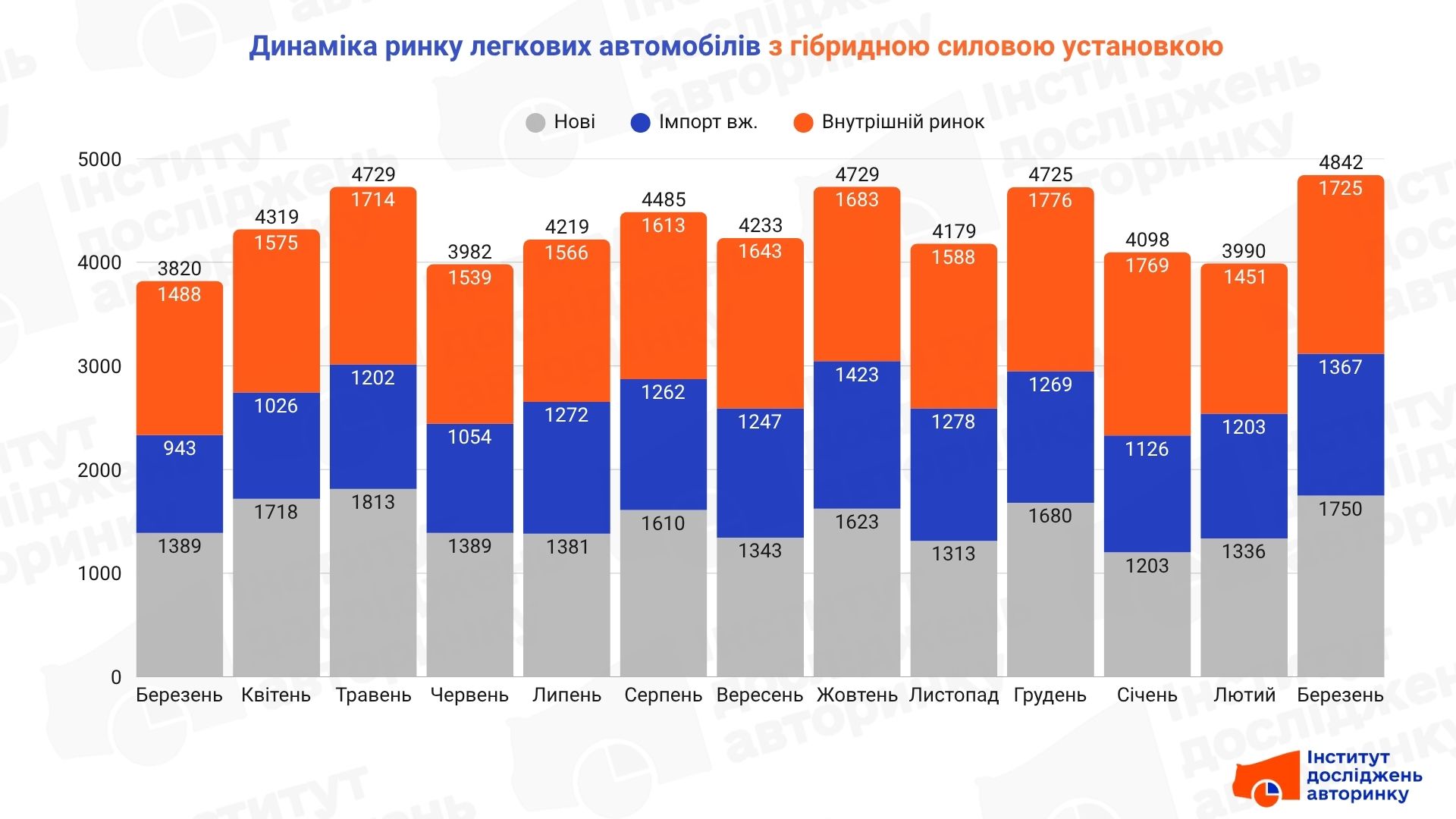
Experts from the Institute of Automotive Market Research have summarized the results for the segment of passenger cars with hybrid power plants for the 1st quarter of 2026. Compared to the peak fourth quarter of last year, there is a slight seasonal cooling, but in annual terms (YY) the dynamics are positive. The market for "freshly driven" hybrids grew by almost 57% compared to the first quarter of last year.
- Check the history of your car by VIN code using CEBIA!
Hybrids have the largest market share among new cars, almost a third — 32%. They hold 7.7% in used imports, and 2.4% in the domestic market.
Domestic market
In the domestic secondary market (4808 transactions), the Japanese school of hybrid construction is completely dominant. Buyers vote for time-tested platforms that have proven their endurance for decades. Crossovers and business sedans from the market leader are perceived as "hard currency": they slowly lose value and have a huge resource, which is critically important when buying a used car. This is the choice of those who want premium comfort or high versatility with minimal fuel costs in the urban cycle.
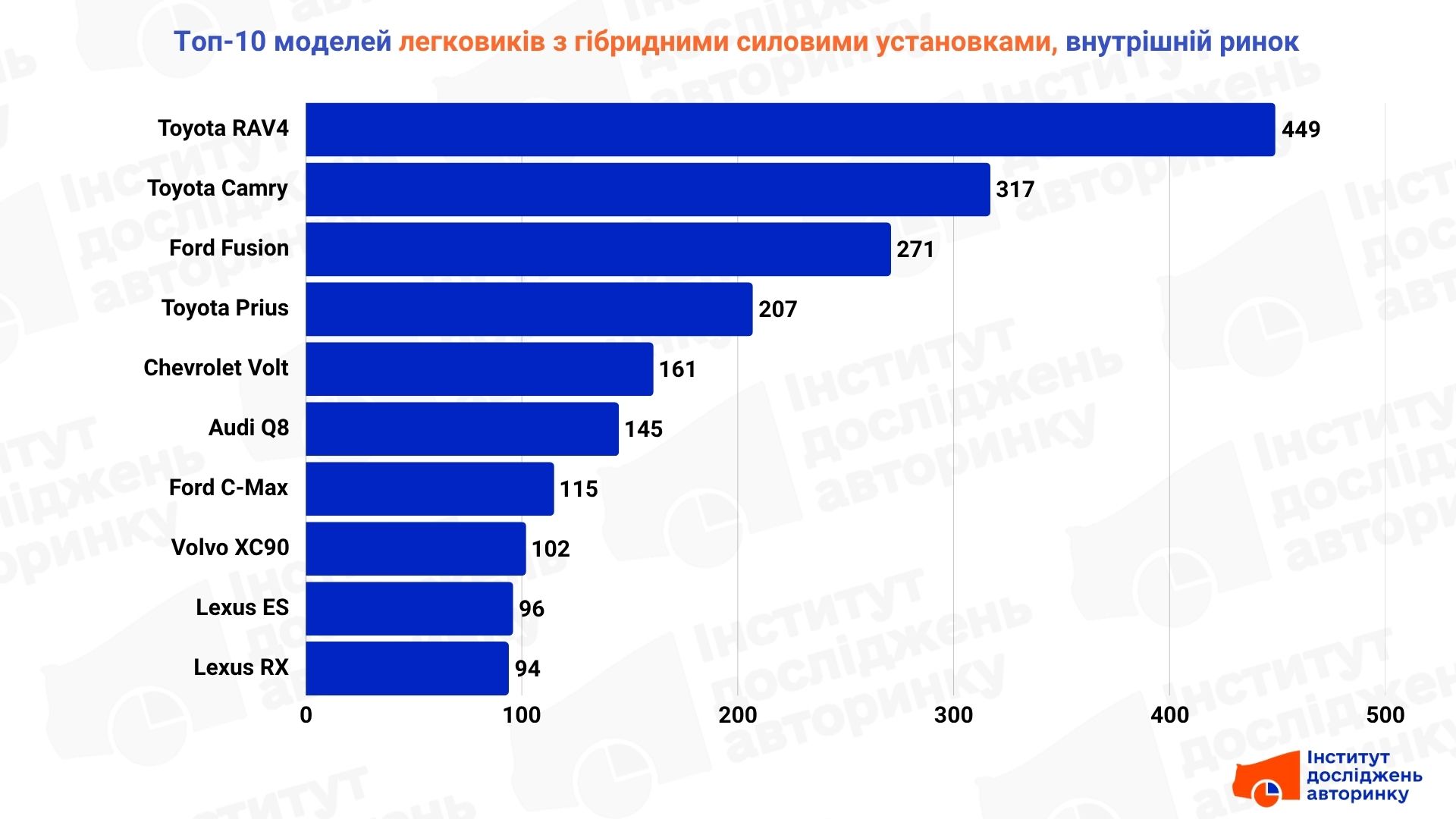
The second large segment of the domestic market is vehicles imported from the North American market. Popular American sedans and hatchbacks have become an entry ticket to the world of hybrids for many Ukrainians due to their affordable price and good equipment. In addition, the premium segment of European crossovers has become noticeably more active in March resales, which are increasingly appearing in reports, displacing older diesel counterparts.
Import of used hybrids
In the segment of “freshly driven” hybrids (3697 units), we see an interesting shift towards universal crossovers. Despite the fact that classic models, which have become synonymous with the word “hybrid”, still hold the top positions, they are increasingly being displaced by modern SUVs. Ukrainian carriers and private customers are looking for cars with high ground clearance in Europe and the USA, which at the same time fit into reasonable fuel consumption standards. The March increase in prices for diesel fuel to UAH 86 only fueled this interest, making the import of a hybrid much more profitable than the search for “clean” diesel fuel.
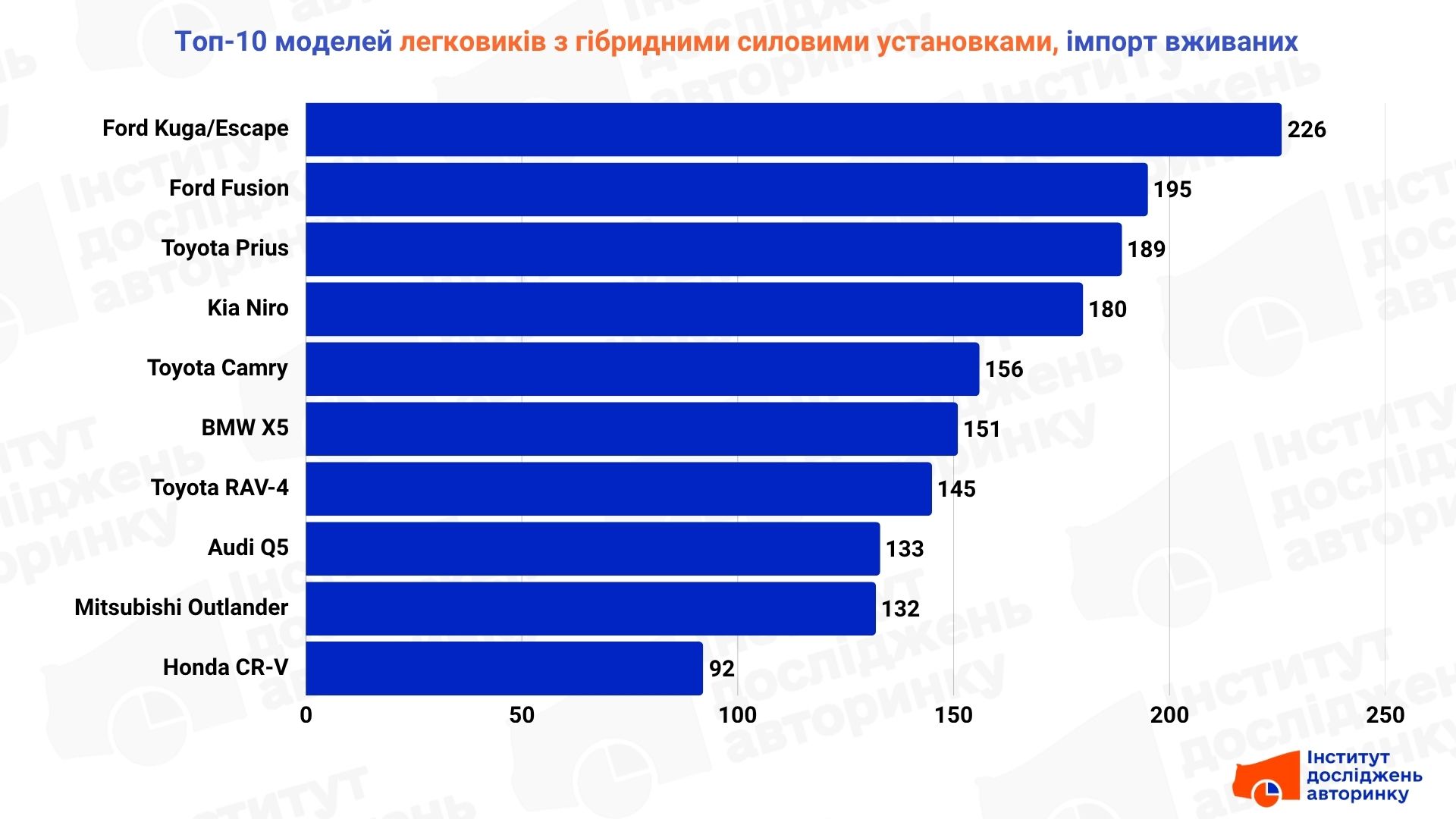
A separate niche in imports is occupied by Korean and European models that offer modern technologies at a competitive price. Interestingly, in this segment, premium German SUVs with hybrid systems are beginning to occupy positions that previously belonged exclusively to diesel versions. This indicates that even in the segment of premium cars with mileage, energy efficiency is becoming the No. 1 priority.
New car market
The segment of new hybrids (4289 units) is the territory of undisputed leadership of one Japanese brand. The indicator of over 1000 sold crossovers of one model per quarter speaks for itself: this is a new "peopleʼs car" for those who have the budget for a new car. The combination of reliability, recognition and real fuel economy makes this model unattainable for competitors. The hybrid here is no longer perceived as an experiment, but as the basic standard of a modern car. At the same time, if we were to imagine this subsegment without RAV4, the picture in terms of volumes and shares would be completely different. This is not yet a "theater of one actor", but a significant part of new car sales is based on one model.
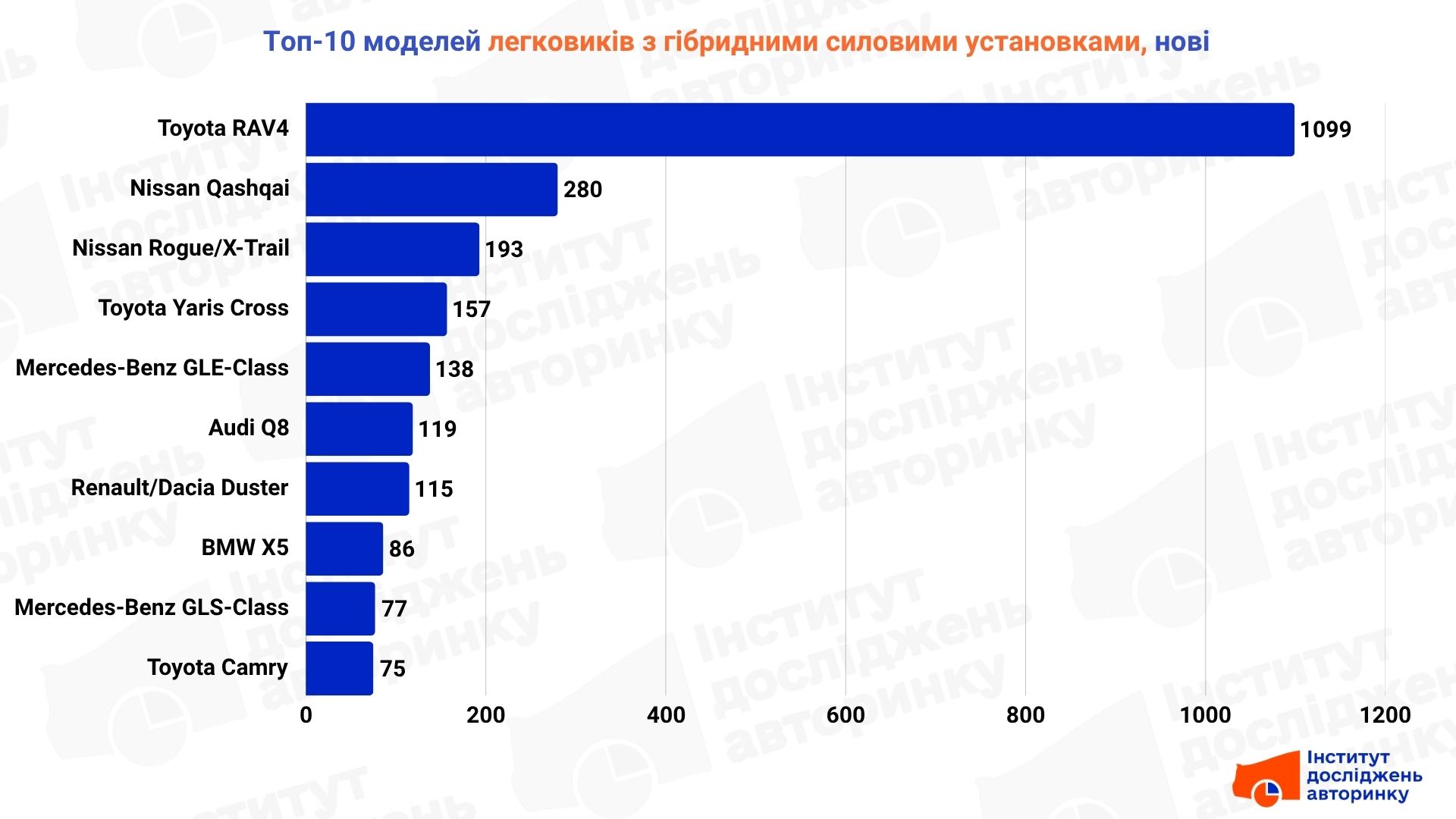
European and other Japanese models individually account for much smaller shares in the auctions. Some of the models are kept in the top ten thanks to innovative drive schemes, where the internal combustion engine acts only as a generator. In addition, luxury German brands confidently hold the top 10, whose flagship SUVs in hybrid versions have become the main choice for corporate fleets and individual private customers.
Conclusion
The first quarter of 2026 confirmed: hybridization of Ukraine is not a fashion for ecology, but a sober economic calculation. With the increase in the price of gasoline to 72 UAH and diesel to 86 UAH at the end of the first quarter, hybrids reminded us that they are an alternative for maintaining mobility with acceptable costs for refueling. However, as in previous years, the situation does not change much — hybrids are talked about more often than they are bought. If Toyota products were removed from new cars for the experiment, the picture would be completely different — here the lionʼs share of cars with this type of power plant remains on one brand.
In general, hybrid cars were and remain "theoretically attractive" but in reality not so popular (if we consider the total shares in the market of the considered segments) products. Buyers will rather switch to "pure" electric cars, or will remain as faithful as possible to cars with internal combustion engines, in cases where the realities of operation or the ownerʼs internal beliefs do not allow a complete switch to battery electric traction.
- Need more information — order it from IDA!


